

 Travelog - Cyprus
 Travelog New Zealand
 Writers / Traveloggers
 Explore URPs worldwide
Photographing the elusive numbat
By Dr Phil Tucak, Wildlife Outreach Vet.
WAYNE LAWLER was an incredible photographer of wildlife, people and Australia’s sublime landscapes, and I was fortunate to work with him at Australian Wildlife Conservancy.
In my role as communications manager, I would regularly speak with Wayne by phone to discuss photography requirements for publications and updates we were producing. He would be camped somewhere in his trusty 4WD camper truck, parked up in yet another remote but beautiful corner of Australia, meticulously taking photographs and cataloguing his images, which he’d then send through to me for uploading into the organisation’s digital library.
We always had a good laugh, with our conversations frequently diverging off into updates on the latest news from the office, discussions on photography techniques, and Wayne sharing insights into whatever amazing rare wildlife species he’d somehow managed to find in the bush and photograph.
Wayne’s sense of humour was evident when he sent me this farewell picture (right) — showing him loaded up with his myriad photographic equipment, and referencing his heavy photographic workload in the field, which I may have contributed to through my role — but whilst also hopefully providing some regular camaraderie and support to him from thousands of kilometres away.
And so, with Wayne’s passing — in addition to the many thousands of wonderful photographs he has left us all with, his legacy is also maintained through Wildlife Queensland’s Wayne Lawler Nature Conservation Photography Grant which I was incredibly grateful and honoured to be awarded in 2025.
In search of elusive numbats
My photographic project for this grant focused on numbat (Myrmecobius fasciatus) conservation, to raise awareness of this critically endangered marsupial, which was probably found across large swathes of Australia prior to European settlement here.
However, sadly now due to a combination of threats such as loss of habitat and the impact of introduced predators such as foxes and cats, the numbat is only found in the wild in Western Australia, along with several populations within feral predator-free fenced sanctuaries in several other states.
Taking photographs of Australian wildlife species can be challenging, particularly because many of them can be elusive and adept at quickly disappearing into the surrounding bushland — and the numbat is no exception. With only about 3000 numbats in existence, finding one in the wild to photograph was challenging, frustrating and exciting, requiring quiet determination, patience and persistence.
I spent days searching through the jarrah (Eucalyptus marginata) and wandoo (Eucalyptus wandoo) forests of south-west Western Australia, varyingly accompanied by family members, expert ecologists, and often on my own.
I saw wildlife including an emu (Dromaius novaehollandiae), echidna (Tachyglossidae), wallaby (Notamacropus), wedge-tailed eagle
(Aquila audux) and black cockatoos (Calyptorhynchus banksii), along with beautiful orchids (Orchidaceae) and other wildflowers.
I sought advice from many sources and am grateful to all those who shared tips on where to potentially find numbats and how to give oneself the best chance of taking some good photographs.
Wayne LawlEr ‘watching over’
It was during those long hours spent slowly scouring the forests of Dryandra Woodland National Park, Boyagin Nature Reserve, Greater Kingston National Park and Tone-Perup Nature Reserve, that I often imagined Wayne gently chuckling away to himself as he oversaw my endeavours from above. There were definitely a few times when I even silently pleaded with him to help me find a numbat, in an accessible location, with good natural light and nicely framed background.
And well, whether or not it was with Wayne’s intervention, when I did finally find a numbat, the combination of location, light and background — was glorious!
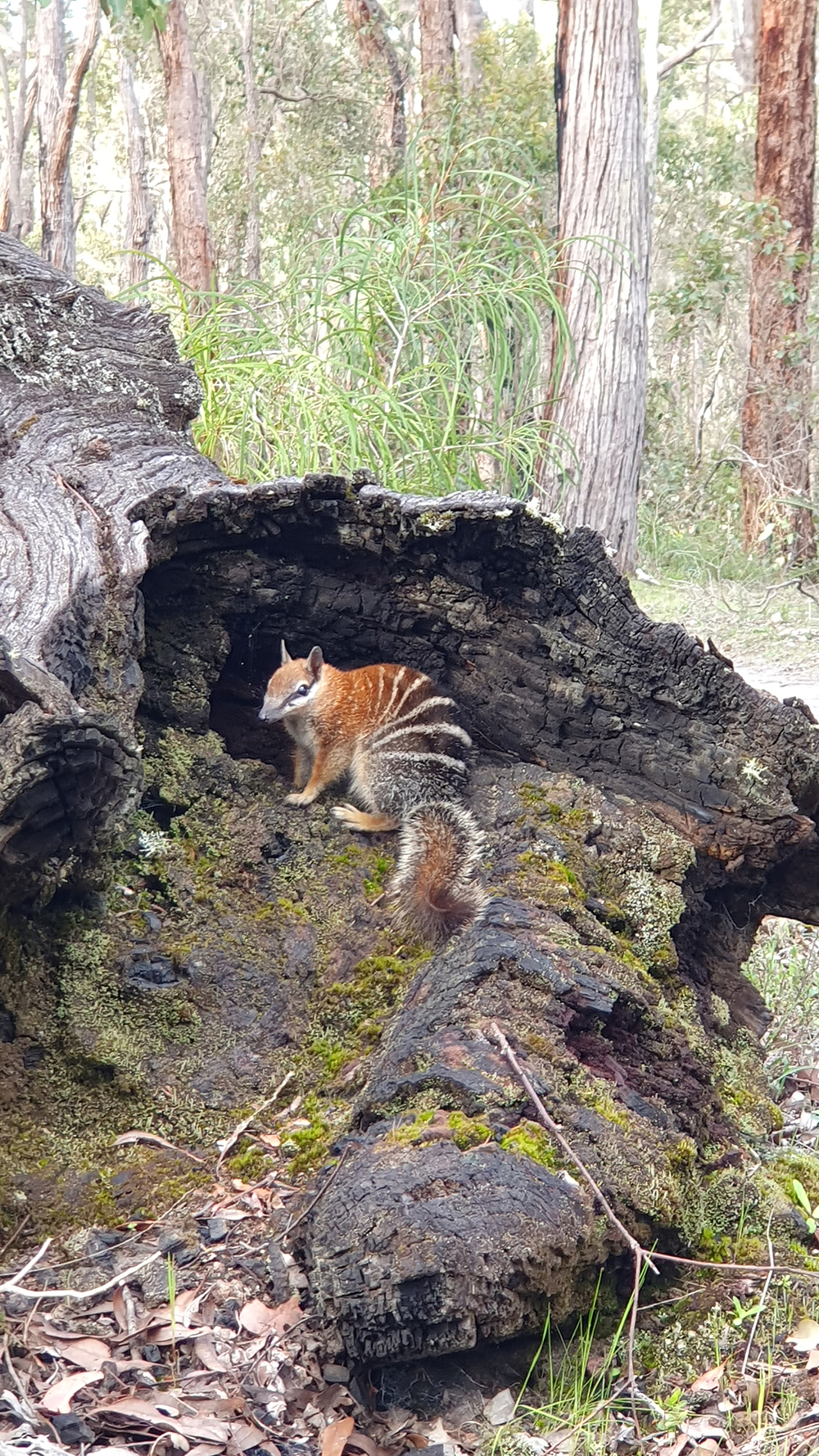
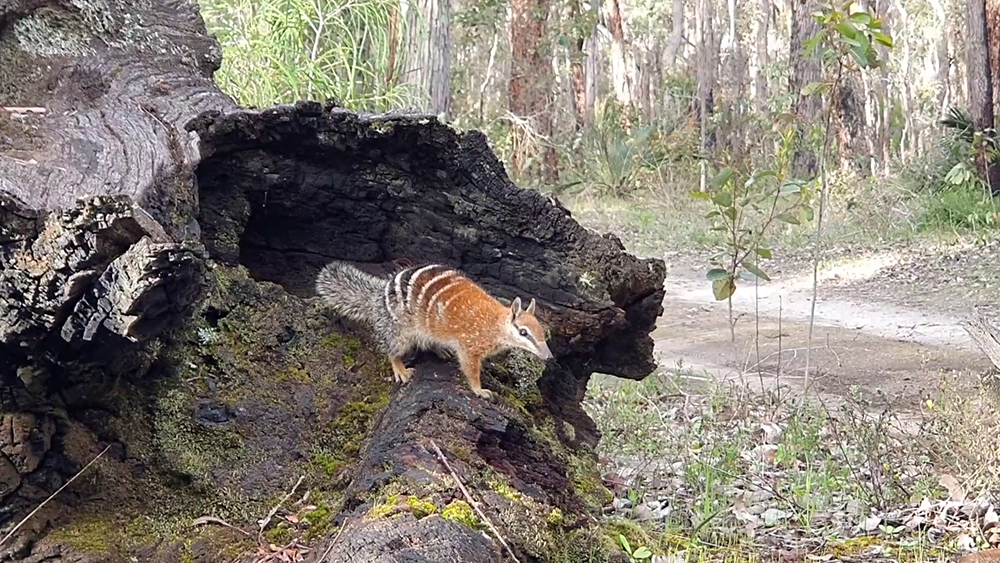
The result is the images shared here, from the Tone-Perup region. Resplendent in the late afternoon sunlight, this delightful female numbat was a fantastic representative of the species. With her distinctive banded body colours, masked thief-like facial markings and bushy tail — one can easily see the resemblance to the numbat’s extinct relative, the thylacine or Tasmanian tiger.
Research scientist Dr Tony Friend has dedicated his career to studying and helping the numbat. Back in the 1980s he started working in a scientific role with the Western Australian Government, and he is also a founding board member of Project Numbat, a community group focused on raising awareness about numbat conservation.
I accompanied Tony and fellow Project Numbat board member, ecologist Rob Hemsworth, on a trip through Boyagin Nature Reserve south-east of Perth to check and service remote camera traps, an activity that volunteers from Project Numbat undertake every three months. Tony was generous in sharing his insights into numbats, including about the species potential wider impact on other wildlife and plants through their role as ecosystem engineers.
“Numbats will dig hundreds of small pits about 2cm to 5cm deep in the substrate that intercept termite galleries, allowing the marsupial to use their long tongue to extract the termites,” he said.
“While the ecosystem function of numbat pits has not been investigated, work on similar pits dug by the marsupial woylie (Bettongia penicillata, also known as a brush-tailed bettong) show that these pits aerate the soil and increase its wettability, promoting plant growth.
“I recall other research that indicates these micro-pits form germination sites for seeds that fall, are blown or washed into them. The other important role that numbats play is the excavation of tree hollows created by termites but blocked by their mud and mound material. Numbats dig them out, making them available for use by numbats and other hole-utilising mammals, birds and reptiles.”
Aust. Wildlife Conservancy takes an interest
Tim Allard is the chief executive of Australian Wildlife Conservancy (AWC), an inspiring organisation with a wide remit working to effectively conserve all Australian wildlife and their habitats.
“AWC’s national scale allows us to take a strategic view of conservation challenges and opportunities,” he said. “We can work across jurisdictions, form partnerships with governments, landholders and NGOs (non-government organisations), and apply best practice science across a range of ecosystems.
“We have the flexibility and agility to act quickly when opportunities arise, and our model allows us to deliver
conservation at scale. Greater public engagement with species like the numbat can drive broader support for conservation, which can only be a good thing for Australia’s threatened wildlife species.”
When I caught up with Tim, he was very chuffed that I’d been awarded this photography grant which bears Wayne’s name, as Tim also has very fond memories of Wayne and his photographic work.
“My first memory of Wayne was at Scotia Wildlife Sanctuary in NSW, where we have a numbat population,” Tim said. “I was standing on the verandah at sunrise when I saw this figure hobbling out of the shadows, leaning on a stick.
“Wayne had twisted his ankle out in the field but didn’t want to bother anyone, so he fashioned a crutch from a tree branch and hobbled several kilometres back to base. I nearly had a heart attack! That was Wayne — quietly determined, never wanting to make a fuss, and entirely committed to getting the shot, no matter the personal cost.
“Wayne Lawler was, in every sense of the word, iconic. His patience, deep knowledge, and dedication to his craft were extraordinary. Much of AWC’s early success — particularly in storytelling and public engagement, can be traced to Wayne’s imagery. He had a remarkable ability to photograph cryptic and elusive species in their natural environments,” Tim said.
“His work shaped how Australians saw their own landscapes and wildlife. Wayne was also incredibly generous — he mentored many people, both within AWC and beyond, and his quiet, humble spirit left a lasting impression on everyone who worked with him.”
The power of nature photography
As Tim also highlighted, Wayne deeply understood the power of photography — it’s not about self-promotion, it’s about connecting people to nature.
“Wayne was always humble. While many tried to put him on a pedestal, he was quick to jump down. I think he would be quietly proud that his work continues to have an impact, though perhaps slightly embarrassed by the fuss,” Tim said.
“His images told stories that words could not. They inspired awe, understanding, and action. His legacy continues to shape how we talk about and care for Australia’s wildlife.”
Wayne Lawler’s ethos is something I’ve attempted to emulate with this photography project. Because however many words one might write on a page, it will always be the accompanying photographs which catch the eye, make an impression, and inspire curiosity to learn more.
Along with the numbat photographs I took, I shared content about this grant project on social media, and wrote a feature article about numbat conservation for Vet Practice Magazine to help raise awareness of the species and the important work underway to conserve them.
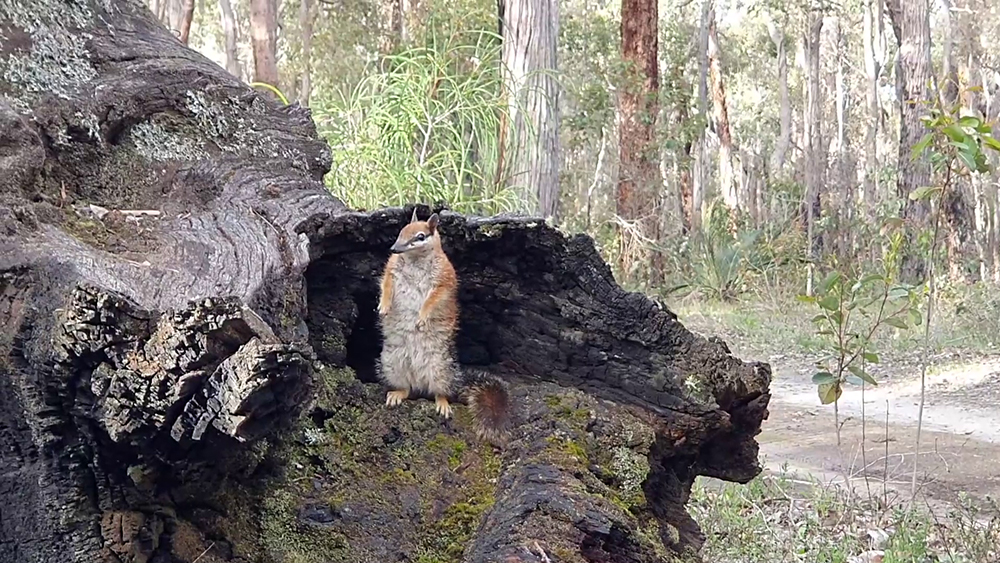
The elusive numbat (Myrmecobius fasciatus). Photo: Phil Tucak — Wildlife Outreach Vet.
FURTHER READING
The online version of the Vet Practice Magazine article is available to read here: https://mags.engagemedia.com.au/vet-practice-magazine-january-2026/full-view.html?p=12
A personal appeal from Dr Phil Tucak
THERE ARE MANY WAYS that we can all help the numbat, such as by keeping pet cats contained indoors or in enclosed outdoor areas, planting trees and extending habitat, driving carefully in areas where wildlife abounds, observing wildlife respectfully and not impacting their activities.
We can also support organisations like Project Numbat, Australian Wildlife Conservancy and Wildlife Queensland —
whether through volunteering, making a donation, or helping to share the conversation about wildlife conservation.
I would like to sincerely thank Wildlife Queensland for awarding me the Wayne Lawler Nature Conservation Photography Grant 2025, and I want to gratefully acknowledge the support of Tim Allard and Stella Frisina from Australian Wildlife Conservancy, Tony Friend and Rob Hemsworth from Project Numbat, and fellow numbat enthusiasts for their helpful insights: Jimmy Lamb, Joanna Glynn and Evangeline Tucak.
To view Phil’s video of a numbat in the wild, visit: https://shorturl.at/SL9dJ
Support Project Numbat: www.numbat.org.au | Australian Wildlife Conservancy: www.australianwildlife.org | Wildlife Queensland: wildlife.org.au
♦ ENDS
- Hits: 137